


Circa 1930: Wayang (Chinese Opera)
PART TWO - MOVING TO SINGAPORE
Life in the village went on the same way until my paternal grandmother, Low Keok Hee (Liu Kexi), fell ill.
For several months leading up to her demise, my paternal grandmother did not have an appetite and complained of difficulty in swallowing. She gradually grew weaker and eventually could not get out of bed. Day and night, someone had to be by her side to take care of her. Her 4 daughters-in-law who lived in the village, namely the wives of my father's 1st, 5th and 6th older brothers and my mother, had to take turns to sleep by her side each night.
DEMISE OF MY PATERNAL GRANDMOTHER
In 1933, on the 5th day of the 8th month in the Chinese lunar calendar, my paternal grandmother passed away. I recall it happened in the afternoon. She was 71 years old at that time, a ripe old age in those days. She was born in 1862, in the 11th month of the Chinese lunar calendar.
Upon her death, the village was abuzz with activity. Everyone rushed back from the rice fields and vegetable farms, and the men took charge of organizing the wake and of breaking the bad news to the relatives and friends in other villages. My aunts, i.e. the daughters of my paternal grandmother, who were married off to other villages were one of the first who had to be informed.
My paternal grandmother's oldest daughter married a man who lived in a village in "Yee Koi" as well. She was the one I mentioned in Part One who eventually passed away on board a boat from Singapore to China. Her village was less than an hour away by foot.
My paternal grandmother's second daughter married a man with the "Liu" surname. Her village was closer to my mother's village, which was about 4 hours away by foot. The name of my aunt's village was "Black Stone" and it produced starfruits. Each time my aunt visited us, she would bring a basket of starfruits for us. This aunt of mine was particularly close to my paternal grandmother. I recall that during my paternal grandmother's illness, my aunt was ill as well. She could not visit my paternal grandmother, so she sent her regards via a messenger. My paternal grandmother who was concerned about my aunt's health sent my cousins and I to visit her. My paternal grandmother said to let my aunt know that if she could turn into a bird and fly, she would fly to my aunt's side right away. Unfortunately, she could not. My cousins and I repeated to my aunt my paternal grandmother's exact words. On hearing them, tears flowed from her eyes.
My paternal grandmother's youngest daughter married a man with the surname "Lim". Her village was also in "Yee Koi" and was less than an hour away by foot. The name of her village was "The Garden Below". Whenever she returned to our village, she would bring egg rolls and biscuits for the children to eat.
When my paternal grandmother passed away, all 3 daughters quickly returned to our village.
THE WAKE
As my paternal grandmother entered her old age, she began to make preparations for her passing. As far as I could remember, there was a storeroom in the village which housed a large tree trunk chopped into 4 sections. I learnt that years ago, there was a great flood which uprooted this big tree. Some people fished the tree trunk out from the water and my paternal grandmother bought it, so there would be wood to construct her coffin. A set of elaborate clothing with many different layers was also purchased so she could be dressed in it upon her demise. I recall that each year, in the 5th month of the Chinese lunar calendar, my paternal grandmother would sun this set of clothing. My cousins and I refused to look at the set of clothing because we did not want to see what the deceased wore!
The wake for my paternal grandmother lasted 1 week. An elaborate altar with her name and incense was placed in front of the coffin, made out of wood from the tree trunk. The children and grandchildren dressed as mourners did in those days - in beige clothes with a hoods made out of a certain type of grass. We knelt by the side of the coffin and cried out loudly when relatives and friends stood before the altar to pay their last respects. Children and grandchildren who did not cry out loudly were seen as being not filial. To prompt us to cry out loudly, the Taoist monk engaged to perform the last rites would ring a bell whenever the relatives and friends approached the altar. Sons of my paternal grandmother would bow to those who paid their last respects.
When performing the last rites, all the mourners circled the courtyard in front of the ancestral home, snaking behind the Taoist monk, who would chant my paternal grandmother's name and our names as he led her spirits to heaven. Money was given to the monk to "pay toll" to the guards of the afterworld. This money was of course kept by the monk in the end!
On the day of the funeral, a few hundred people turned up in our village. Food had to be cooked to feed everyone who came. After the meal, the funeral procession took place. At the advice of geomancers, my paternal grandmother was to be buried at a cemetery about an hour away by foot from our village. Eight pallbearers carried the coffin on their shoulders to the burial ground, followed by the men in the family, and the womenfolk and children. The womenfolk and children were only allowed to go so far as the mouth of the village before turning back. Only the men proceeded to the cemetery. My paternal grandmother was not buried alongside my paternal grandfather (who passed away when my father was still young). My paternal grandfather was buried at Pak Kee Hill, further away from our village.
The mourning period lasted for 2 years. To signify that we were in mourning, we wore armbands and dressed in somber colours.
FESTIVALS & EVENTS
At this juncture, I should touch on some of the festivals and events in China, which although exist in Singapore, were celebrated differently in China.
The night before the 1st day of the 1st month of the Chinese lunar calendar is when the Reunion Dinner is held. When my paternal grandmother was still alive, the families of her sons, who were living in the village, would take turns to have Reunion Dinner with her. Traditionally, the first stop she made would be at her oldest son's house. My family would be the last, since my father was her youngest son. I recall having to wait till very late to have dinner that night.
Reunion Dinner was also the only time of the year when a chicken and duck would be killed and served. We could not bear to consume the whole chicken and duck at one seating, so my mother would only serve a portion of it and preserve the rest with salt. We did not have a refrigerator in those days. Salting the meat allowed us to enjoy the meat for a few more days. Aside from chicken and duck, fish, pork leg, vegetables with mushrooms and soup were also served with rice.
The 1st day of the 1st month of the Chinese lunar calendar would be the start of the Chinese New Year. Unlike in Singapore, when the first and second days are public holidays when people visit their relatives, not much celebration was done on those 2 days. We only prayed to our ancestors at the ancestral home.
On the 3rd day, however, there would be a big celebration. We began the day by visiting the temple and praying for peace. My village was too small to have a temple of our own, so we shared one with 6 other villages in the vicinity. That night, the gods (made of wood) in the temple would be dressed up and carried in sedan chairs in a procession accompanied by the sound of loud gongs, drums and trumpets. The procession moved from one village to another, until all 7 villages sharing the temple were covered. Sweets would be offered to those in the procession. Since the procession took place at night, we all held lanterns to light the way. After the procession, there would be a clay doll show with singing in Teochew (our dialect).
The next big celebration would be on the night of the 15th day of the Chinese lunar calendar. The celebration on that night was the highlight of Chinese New Year. In my village, there was a tradition that each family with a son born in the previous year would have to purchase a decorative box of clay dolls and display the box at the ancestral home. Everyone would gather at the ancestral home to admire the clay dolls, count the number of boys born in that year, and enjoy tea and sweets. There was a book in the ancestral home which recorded the number of boys born. Girls were never registered in that book. Once girls got old enough, they would be married away to other villages and would belong to their new villages. There would also be a fireworks display coupled with the lighting of firecrackers just outside the ancestral home. It was a noisy and happy affair.
In some years, I celebrated the 15th night at my mother's village instead. My mother rarely came with me, and I would walk there with my mother's youngest sister. With more than 10,000 people in my mother's village, the celebrations there were always more elaborate. My mother's village had a unique tradition of displaying all brides who got married the previous year that night. The brides would dress up beautifully, then sit and wait in their houses. Red lanterns would be hung outside their houses and an open-door policy was adopted that night. Anyone could walk into their houses to take a look at them, and they would offer complete strangers tea and sweets. It was a really strange tradition. Some of the brides had gotten married quite a few months back and they would be pregnant! The only brides who were exempted from this would be those who had just given birth. Even then, they had to make up for it by being put on display the next year! My mother's village would also have wayang (Chinese opera) to watch. I always enjoyed myself more when I visited my mother's village during Chinese New Year.
The 3rd month of the Chinese lunar calendar would be Qing Ming Festival, when the men in the family would visit the tombs of their ancestors, together with the children. I always enjoyed myself during Qing Ming Festival because it was the only time of the year when I got to travel further away from our village. There were 2 different places I used to go to which I still remember today.
The first would be "Teck O" (Deer Lake), where one of my ancestral fathers was buried. It took a full day to go and return. To get there, we even had to take a boat. Each boat carried at least 15 people, plus 2 boatmen. As the boat had to travel upstream to get to the cemetery, the boatmen exerted tremendous strength to propel the boat forward. The river was relatively shallow, with a sandy bottom. The boatmen would stick a bamboo pole with a sharp metal end into the sand and then walk the length of the boat with one end of the bamboo pole attached to their shoulder by a strap. It is difficult to imagine, but I assure you the boatmen were incredibly strong. When we got to the cemetery, it would be time for lunch. We would gather bricks, wood and twigs to start a fire to cook our lunch, which consisted of rice or porridge, cockles and fried vegetables. We would have a picnic near the tomb of our ancestral father. After our meal, we would clean and weed the area around the tomb and leave the empty cockle shells on the tombstone, as a sign to others that we were filial and had visited the tomb. White and yellow joss paper would be left around the area of the tomb for the same purpose. When we were about to depart, the adults would remind the children to pray to the ancestral father and we would all kneel down and bow.
The second place I recall visiting would be "Lam Swa Ow" (Back of the Blue Hill). That place was also far away and required a full day to go and return. It was out of "Teo An" and was closer to a place called "Jeo Peng". The ancestors were all buried at different places, as in those days, burial places were determined by geomancers. The entire village would visit the tomb of the ancestral father buried there. His tomb was a very big one and I recall there was a village at the base of the hill. For a reason unknown to me, my uncles would always carry tins of biscuits and distribute the biscuits to the children living in that village every year.
Another significant festival took place in the 11th month of the Chinese lunar calendar. Glutinous rice balls would be boiled in sweet soup and placed in pairs at certain strategic spots, like by the side of the freshwater well, the kitchen and the stone grinder. My paternal grandmother once explained to me that this was done to give thanks, for instance, to the gods of the freshwater wells for being kind in providing fresh water to the village for the entire year.
TRAVELLING TO SINGAPORE
After Chinese New Year in 1934, my father sent 100 silver taels to my mother. He had written to send for us. My mother no longer had to take care of my paternal grandmother and my father wanted us to join him in Singapore.
My mother was initially unsure of whether to make the trip, so she returned to her village to consult her parents and siblings. Her parents were reluctant to see her go, but her older brother encouraged her to do so. He reasoned that my father had already sent her the money to purchase the boat tickets, and he was after all her husband. My mother made up her mind and contacted a guide who made a living out of escorting people from China to Singapore. The guide made all the arrangements for our trip to Singapore, including buying the boat tickets. I remember the fare for adults was 60 silver taels, for children was 30 silver taels and for infants was free. My mother bought a luggage and a cane basket for us to fill our belongings. We packed what we could, and left the bulk of what we owned in the care of the wife of my father's sixth brother (who had gone missing in Johore Bahru). I recall my mother even bought new shoes for my younger brother and I.
Before we left, many relatives and friends came with gifts of fruits and dried foodstuff. I still remember one of my uncles gave us 12 big mandarin oranges for the trip. My cousin, the eldest sister of "Twin Peaches", suggested to me that I should cut off my plait as it was probably fashionable in Singapore to have short hair. I agreed and in a snip, my plait was gone.
Just before we left, we visited my mother's village a final time to bid farewell to her parents and siblings. We also said our prayers at the ancestral home in my village. After that, my father's eldest brother escorted us to Shantou by train. Shantou was a large city and the boat to Singapore was docked there. I recall we arrived in Shantou in the afternoon and the guide took my mother, younger brother and I to a clinic for our shots. It was probably to "clear the poisons from our bodies". After that, the guide took us to a large departmental store in the city. It was the first time I saw a departmental store of that size. In the town called "Huxiah" near my village, there were 2 departmental stores - Eng Hwa and Ngee Hwa. Neither were as large as this one in Shantou. That night, we stayed in a guesthouse.
The following day, my mother bought some dried pork head for my uncle. He gave us his best wishes, then made his way back to our village.
There were altogether about 12 people (4 men in their 40s, and the rest were women and children) who were under the care of the same guide. Although we were all from different villages, we all spoke the same dialect, Teochew.
There was a long queue to get on board the boat to Singapore. I still remember the name of the boat; it was called "Guangcang". To get on board "Guangcang", my mother, younger brother and I had to take a small boat, then step quickly across an unstable wooden plank onto Guangcang. Once on board Guangcang, there was again a queue to produce our boat tickets.
Before Guangcang sailed away from the harbour, the passengers had to file slowly past the crew on the deck for them to do a headcount. I remember there were about 600 people on board. At that time, China was about to enter into the Sino-Japanese war and the Chinese government had implemented a system to compel men to join the army. A family with 3 sons would have to contribute 2 sons for the national effort, a family with 2 sons would have to contribute 1, and where there was only 1 son in the family, that son need not be enlisted. Lots of people fled China as a result of the impending war, and our boat was severely overcrowded.
The boat, which was built as a cargo boat originally, had quite a few decks. The bottom few decks were filled with goods. The next few decks had wooden floorboards, without any beds. These decks were where the commoners and crew members slept. The open-air deck was where more goods were stacked and where the kitchen and toilets were. The next few decks were where the rich had their cabins.
My mother, younger brother and I slept where the commoners slept, on the wooden floors. Our guide escorted us together with the rest in our group to the sleeping quarters. The womenfolk and children in our group surrounded our area with our luggage and belongings, whilst the men went to find their own places to sleep. We lay mats on the wooden floor. Each of us had brought our own pillows, blankets and towels. We sat on our mats and chit chatted with the rest in our group. At the sound of a loud horn, the boat set sail.
I recall there were potholes which could be opened for ventilation in the sleeping quarters. At times, water would splash into the sleeping quarters and everyone would get all excited. The route between Shantou and Hongkong was particularly treacherous, as the sea was very choppy. The boat bobbed up and down and almost everyone got seasick. Many, including my younger brother, threw up. My mother was too giddy to get up, but I was very fortunate. I did not feel seasick so I helped those who did. I ran to fetch water for some and wet their face towels for them. Our guide cleaned the vomit from the wooden floors.
The next morning, we arrived in Hongkong. The boat was docked a day in Hongkong to load and unload some goods. Some people got off the boat to do some sightseeing in Hongkong, but my mother, younger brother and I remained on board. We were afraid of missing the boat if we got off. I stood by the potholes and watched the day go by. I saw goods being loaded and unloaded and I watched a man skillfully climb on board our boat to sell green bean soup. The man only had a little boat. He had no wooden plank to link his boat to Guangcang, yet he was able to climb aboard by latching onto a big wave and catching hold of the rope ladder. Lots of people bought the green bean soup from him, but my mother did not. She wanted to conserve our cash.
Meals on board Guangcang were provided. We queued to get our meals from outside the kitchen with our own utensils. My mother had packed for each of us a mug, a pair of chopsticks and a spoon. We used the mug to fill porridge or rice, and heap some egg or vegetables on top. We washed our own mugs, chopsticks and spoons after the meal.
There were toilets on the open-air deck. To get to them, we had to walk past baskets of vegetables and garlic. The garlic emitted a really bad stench when they were being baked in the sun. The toilets were clean, as seawater was continually flushing out the sewage. There was barely a trickle of freshwater for us to take our showers. With so little water, we did not bathe everyday.
After departing from Hongkong, we did not see any land or any other boats until the night before we arrived in Singapore. On one day, however, the boat passed an area where there was a lot of flying fish. The guide alerted me of the flying fish and we went to watch the fish rain onto the decks.
As the boat sailed towards the equator, we could feel the temperature rising. The night before arriving in Singapore, the guide pointed out to me the silhouette of 3 hills and said that we were about to arrive in Singapore. The next morning, I saw land, kelongs (Malay fish farms on stilts out in the sea) and fishermen. We were nearing Singapore and I felt very excited.
Before noon, all of us had to file past the crew for the headcounting once more. I recall walking round and round the decks so many times for the headcounting that my legs were tired. The 2 crew members making the count kept getting numbers which did not tally.
By noon, the boat arrived at the docks in Tanjong Pagar, Singapore. Right after we got off the boat, my younger brother spotted a hawker selling prawn noodle by the side of the road. He was hungry and pestered my mother to buy him a bowl. My mother agreed, but we did not have any local currency. The guide changed some currency for us and my mother bought a bowl of noodles for 3 cents. However, before my younger brother could eat much, the bus which was supposed to take us to the Immigration Office arrived.
The Immigration Office was located at Havelock Road, in the building now housing the Family & Juvenile Court. My father was supposed to meet us at the Immigration Office. My younger brother who had never met our father before was very anxious. I told him that when I greeted our father, he should do the same.
My mother and I spotted my father at the Immigration Office. We were all so happy to see him. He had to come forward to sign some papers before my mother, younger brother and I could formally enter Singapore.
The guide informed us that our luggage was at a Teochew guesthouse along Hill Street. We thanked him for his help and went on our way. My father hired 2 rickshaws to take us to the guesthouse in Hill Street. The rickshaws could seat 2 each. I sat with my father, whilst my mother took the other with my younger brother.
It was 1934, and early in the 4th month of the Chinese lunar calendar. My mother was 31 years old, I was 12 and my younger brother was 7. We were beginning a new life in Singapore.
~ Return for Part Three ~

Circa 1930

Circa 1930: Chinese Junk Boat

Circa 1930: Coastline of Singapore

Circa 1931: Raffles Lighthouse
.jpg)
Circa 1930: The Harbour

Circa 1930: At the Docks

Circa 1935: Coolies at the Wharf

Circa 1930: Street Market

Circa 1930: Street Food Vendor

Circa 1930: Satay Man

Circa 1935: Dumplings for Sale

Circa 1930: Trolley Bus

Circa 1935: Mosquito Bus

Circa 1930: Rickshaw Puller

Circa 1930

Circa 1935: Sikh Policeman

Circa 1934: Bullock Cart

Circa 1930: Hill Street

Circa 1930: High Street

Circa 1930: Victoria Street

Circa 1930: North Bridge Road

Circa 1930: South Bridge Road

Circa 1930: Padang & The Municipal Hall (now part of the High Court)

Circa 1930: Raffles Place

Circa 1934: Raffles Place

Circa 1935: Raffles Quay

Circa 1931: Collyer Quay

Circa 1930: Victoria Memorial Hall

Circa 1930: Fullerton Building

Circa 1930: Connaught Drive

Circa 1930: Cavenagh Bridge
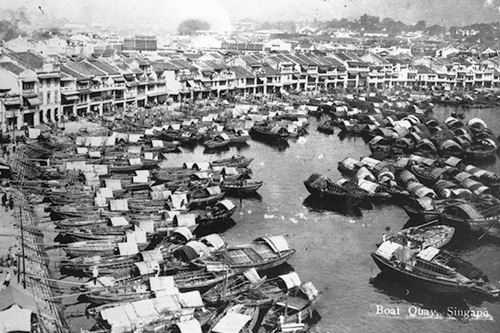
Circa 1930: Boat Quay, Singapore River

Circa 1930: Coolies unloading goods at the Singapore River